

Celebrating 40 Years In ESD - Trusted UK Supplier Of ESD Control Products Since 1986

ESD Brushes and Swabs: The Complete Guide to Static-Safe Cleaning Tools

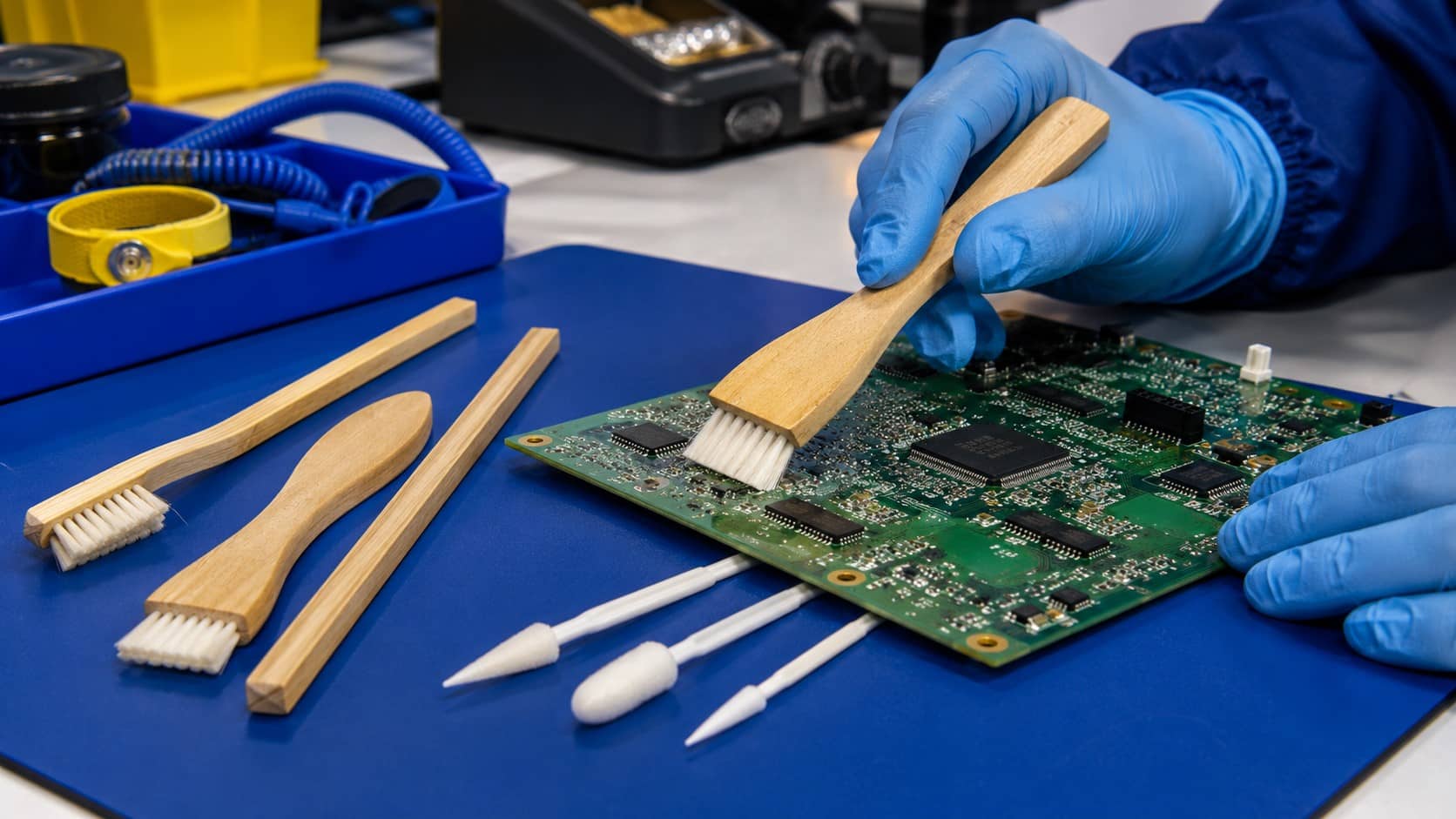
ESD brushes and swabs used for static safe cleaning of a PCB

ESD brushes and swabs are static-safe cleaning tools made with conductive or static-dissipative materials, used to remove dust, flux residue, and debris from electronic components without generating a static charge. Choose a brush for sweeping larger surfaces and components, and a swab for precision cleaning in tight spaces like connector pins, sockets, and PCB pads.

Key Points

  • Standard cleaning tools generate triboelectric charge that can damage static-sensitive components on contact or cause latent failure later
  • ESD brushes range come in various sizes, with either wooden or conductive PP handles and conductive nylon, PA, horse hair or carbon-fibre bristle blends
  • ESD swabs come in paddle, sharp, and round tip styles, in foam or polyester, for precision cleaning
  • Look for IEC 61340-5-1 compliance to confirm a tool is safe for use in an Electrostatic Protected Area (EPA)
  • Conductive and dissipative properties degrade with wear, so tools need periodic testing or replacement, not just visual inspection
  • Bondline has supplied static control products, including ESD brushes and swabs, since 1986

Why Ordinary Cleaning Tools Create ESD Risk

Ordinary brushes and cotton swabs are made from materials that generate triboelectric charge as they move across a surface, plastic bristles rubbing against a PCB can build up several thousand volts of static in seconds. That charge has nowhere safe to go once it contacts a static-sensitive component, and the resulting discharge can cause immediate failure or latent damage that only surfaces weeks later in the field. ESD-safe brushes and swabs solve this by using bristle, tip, and handle materials that dissipate charge as it forms, keeping the tool itself below the voltage threshold that puts components at risk.

When Do You Need an ESD Brush Instead of an ESD Swab?

The right choice comes down to the size of the area you’re cleaning and how much precision it needs. Brushes cover more surface area quickly; swabs get into places a bristle can’t reach cleanly.

Comparison FactorESD BrushesESD Swabs
Best forSweeping dust/debris from PCBs, components, workbenchesPrecision cleaning of pins, pads, connectors, tight gaps
Typical sizes120mm–900mmPaddle, sharp, and round tip styles
MaterialsWooden or conductive PP handle; conductive nylon, PA, horse hair or carbon-fibre-blend bristlesFoam or polyester tips on static-dissipative sticks
Common stylesToothbrush-style, flat-style, paintbrush-stylePaddle tip, sharp tip, round tip

Where Are ESD Brushes and Swabs Used?

ESD brushes and swabs show up anywhere static-sensitive components are handled, assembled, or serviced:

  • PCB assembly lines — removing flux residue and solder debris left behind after wave or reflow soldering, before boards move on to inspection or conformal coating. Leftover flux can interfere with test contacts and coating adhesion if it isn’t removed safely.
  • Cleanroom and EPA benches — routine dust and particle removal from work surfaces, fixtures, and equipment housings, keeping contamination away from open assemblies without introducing a static risk.
  • Connector and component cleaning — swabs reach into pins, sockets, and housings that brushes can’t access, which matters most during rework where a single bent or dirty pin can cause an intermittent fault.
  • Rework and repair stations — precision cleaning during board rework without disturbing surrounding components or leaving residue that could affect a retest.
  • Field service and maintenance — cleaning static-sensitive equipment on-site without needing an ioniser or wet process, useful where power or space for other ESD equipment is limited.

Types of ESD Brushes

Bondline’s ESD brush range spans several styles to match different cleaning tasks:

Types of ESD Swabs

Swabs are distinguished mainly by tip shape, which determines what they can reach:

  • Paddle tip swabs (foam or polyester) — flat, wide tips for wiping flush surfaces and larger pads
  • Sharp tip swabs — pointed tips for precision cleaning inside connector housings and narrow gaps
  • Round tip swabs (foam or polyester) — general-purpose rounded tip for spot cleaning

How to Choose the Correct Cleaning Tool

  • IEC 61340-5-1 compliance — confirms the tool meets the recognised ESD control standard for use in an EPA
  • Conductive handle material — look for conductive polypropylene or zinc-plated metal, not untreated plastic
  • Bristle or tip material — conductive nylon, PA, or carbon-fibre blends for brushes; foam or polyester for swabs
  • Size matched to task — shorter, precision brushes/swabs for component-level work; longer brushes for bench and enclosure cleaning
  • Reach vs precision — if you need to cover a wide area quickly, choose a brush; if you need to get into a specific gap or connector, choose a swab

How to Maintain and Test ESD Brushes and Swabs

Conductive and static-dissipative materials degrade with use — bristles pick up oils and contamination, handles wear at contact points, and foam or polyester tips can compress or harden over time. Unlike a mechanical fault, this degradation often isn’t visible, which means a brush can look fine while its dissipative path has already weakened.

  • Visual checks — look for frayed, matted, or missing bristles, cracked or brittle swab tips, and visible wear on the handle coating
  • Surface resistance testing — for tools in regular high-volume use, periodic checks with a surface resistivity meter against IEC 61340-5-1 thresholds confirm the conductive path is still intact
  • Replacement schedule — in high-throughput EPAs, replacing brushes on a set schedule based on usage is more reliable than waiting for a visible fault to appear
  • Storage — keep ESD brushes and swabs separate from non-ESD-safe tools to avoid accidental mix-ups on the bench, and store them away from contaminants like solvents or abrasive dust

Common Mistakes When Cleaning ESD-Sensitive Components

  • Using a household or workshop brush “just this once” — a single use with an untreated tool is enough to generate a damaging discharge on a static sensitive component
  • Skipping the compliance check — some tools marketed generically as “anti-static” aren’t verified to IEC 61340-5-1, so it’s worth confirming compliance before buying rather than assuming
  • Continuing to use a worn brush — a bristle blend that’s picked up contamination or worn thin can lose its dissipative path well before it looks obviously damaged
  • Mixing ESD-safe and standard tools in shared storage — this creates a real risk of grabbing the wrong tool by mistake, especially in a shared or high-turnover workstation
  • Cleaning without a grounded workstation — a static-safe brush or swab doesn’t create a safe EPA on its own; it needs to be used alongside a grounded mat, wrist strap, and flooring
  • Scrubbing instead of sweeping — excessive pressure or friction can generate charge even with a static-dissipative tool, so a light sweeping motion is safer than vigorous scrubbing

Frequently Asked Questions

Can I use a regular brush to clean electronic components?

No. Standard brushes generate static charge as their bristles move across a surface, which can damage static-sensitive components on contact or cause latent failures later. Always use a brush or swab made from conductive or static-dissipative materials inside an EPA.

What’s the difference between conductive and static-dissipative bristles?

Conductive materials let charge move away very quickly, while static-dissipative materials release it more slowly and controllably. Most ESD brushes use a static-dissipative bristle blend paired with a conductive handle, balancing safe charge dissipation with durability.

Do ESD swabs need to be disposed of differently?

ESD swabs are generally single-use consumables. They should be discarded after use like standard cleanroom swabs — the static-safe property relates to the material composition, not reusability.

What size ESD brush do I need for PCB cleaning?

For detailed PCB and connector work, a toothbrush-style brush in the 175mm–225mm range is typically sufficient. For larger assemblies, boards, or enclosures, a flat-style or long-handled brush (up to 900mm) covers more surface area per pass.

How often should ESD brushes be replaced?

There’s no fixed universal interval, it depends on usage frequency and contamination exposure. In high-throughput EPAs, it’s safer to set a replacement schedule based on usage volume rather than waiting for visible wear, since dissipative properties can weaken before the brush looks damaged.

Can ESD brushes be cleaned or washed?

Washing isn’t standard practice for most ESD brushes, since it can affect the bristle coating or introduce contaminants. Check the manufacturer’s guidance for the specific brush, if in doubt, treat it as a consumable and replace it rather than attempting to clean and reuse it.

Are ESD brushes and swabs safe for use outside an EPA?

Yes, there’s no restriction on using them outside an EPA, they’re simply built to be safe for use inside one. Many workshops use them as standard cleaning tools even where static control isn’t strictly required, since they carry no real downside compared to standard equivalents.

Why Choose Bondline for ESD Brushes and Swabs

Bondline Electronics has supplied static control products across the UK since 1986, and stocks a comprehensive range of ESD brushes and swabs manufactured to IEC 61340-5-1 for safe use in electrostatic protected areas. Whether you need a single precision swab for rework or a bulk supply of long-handled brushes for a production floor, our team can advise on the right tool for your process and offer bespoke sizes on request.

Browse Bondline’s full range of ESD brushes and ESD swabs, or get in touch with our team for tailored advice on the correct tool for your EPA.

Translate

Cookie Acceptance

Some of these cookies are essential, while others help us to improve your experience by providing insights into how the site is being used.

For more information and to read more about our privacy policy, please visit our Privacy Policy

Necessary Cookies

Necessary cookies enable core functionality. The website cannot function properly without these cookies, and can only be disabled by changing your browser preferences.
Analytics (Recommended)

Necessary cookies enable core functionality. The website cannot function properly without these cookies, and can only be disabled by changing your browser Analytical cookies help us to improve our website by collecting and reporting information on its usage. preferences.
×