
 Skip to content
Electrostatic discharge is one of the most prevalent reasons for failure with electronic components. Even a minor static discharge that you cannot feel may weaken or destroy static-sensitive electronic devices. If you are working with electronics, printed circuit boards, or any assemblies, creating an ESD-safe workspace helps protect your products, reduces returns, and aids in meeting the standards of IEC 61340-5-1.
This guide covers how ESD damage occurs, the essentials of an ESD-safe area, and how to put the right controls in place.
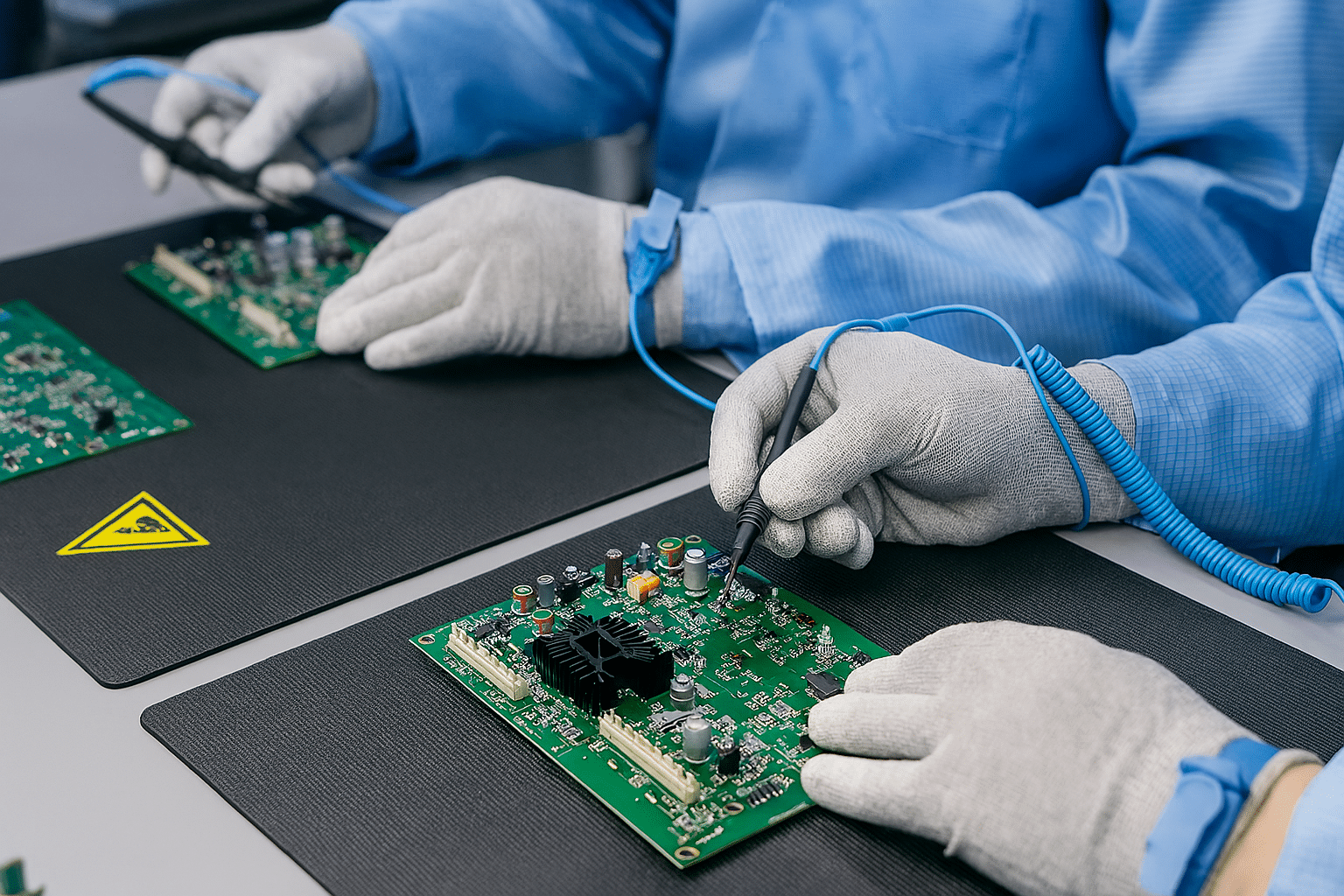
An ESD-safe workspace is a controlled environment (known as an EPA – Electrostatic Protected Area) where static electricity is safely controlled through grounding, dissipative materials, and anti-static equipment to prevent damage to sensitive electronic components.
It typically includes:
Electrostatic discharge (ESD) is a sudden flow of electricity between two objects with different electrical charges.
While humans only feel static at around 2,000–3,000 volts, many electronic components can be damaged at under 100 volts.
This is why ESD protection is essential in electronics manufacturing, repair, and assembly environments.
Before setting up equipment, every ESD-safe environment should follow these core principles:
Grounding is the most critical part of any ESD-safe setup.
A proper grounding system ensures static electricity flows safely to earth instead of damaging components.
All grounding points should be tested regularly to ensure continuity.
Personnel grounding ensures static from the human body is safely discharged.
Many facilities use both systems for full coverage.
Work surfaces control static generation during handling and assembly.
Together, they form a completely grounded working system.
ESD protection doesn’t stop at the workstation.
Static sensitive electronic components must remain protected during handling, storage, and shipping.
Static shielding bags (used for high-sensitivity electronic components like PCBs)
Pink anti-static bags (used for non-ESD items like screws, washers, nuts, bolts)
Conductive boxes and storage totes
Anti-static foam and protective trays
This ensures full lifecycle protection from production to delivery.
Air dryness increases static electricity risk significantly.
Humidity control supports, but does not replace, grounding systems.
Some materials (especially plastics and insulators) cannot be grounded.
Ionisers neutralise static by releasing positive and negative ions into the air.
Types include:
ESD systems must be tested regularly to remain effective.
Proper records should be maintained for audits and compliance with IEC 61340-5-1.
A structured ESD control plan ensures consistency across all operations.
This is essential for IEC compliance.
Even the best equipment fails without proper training.
Regular refresher training improves long-term compliance.
Bondline provides complete ESD control solutions for industrial and electronics environments.
Whether you’re building a single workstation or a full EPA, Bondline supports complete compliance and protection.
It is a controlled area where static electricity is managed using grounding, dissipative materials, and anti-static tools to protect electronic components.
Use a grounded ESD bench, anti static mat, anti static wrist strap, ESD flooring and foot grounders (if needed), and proper ESD packaging while following EPA rules.
Not always. Anti static mats are enough for bench work, while ESD flooring is required for walking or standing operations.
Typically daily or at the start of each shift, depending on your ESD control plan.
Yes. Damage can occur at voltages far below human detection levels.
At minimum: grounded anti static bench mat, anti static wrist strap, grounding cords, and ESD-safe packaging.
Some of these cookies are essential, while others help us to improve your experience by providing insights into how the site is being used.
For more information and to read more about our privacy policy, please visit our Privacy Policy
Necessary cookies enable core functionality. The website cannot function properly without these cookies, and can only be disabled by changing your browser preferences.